
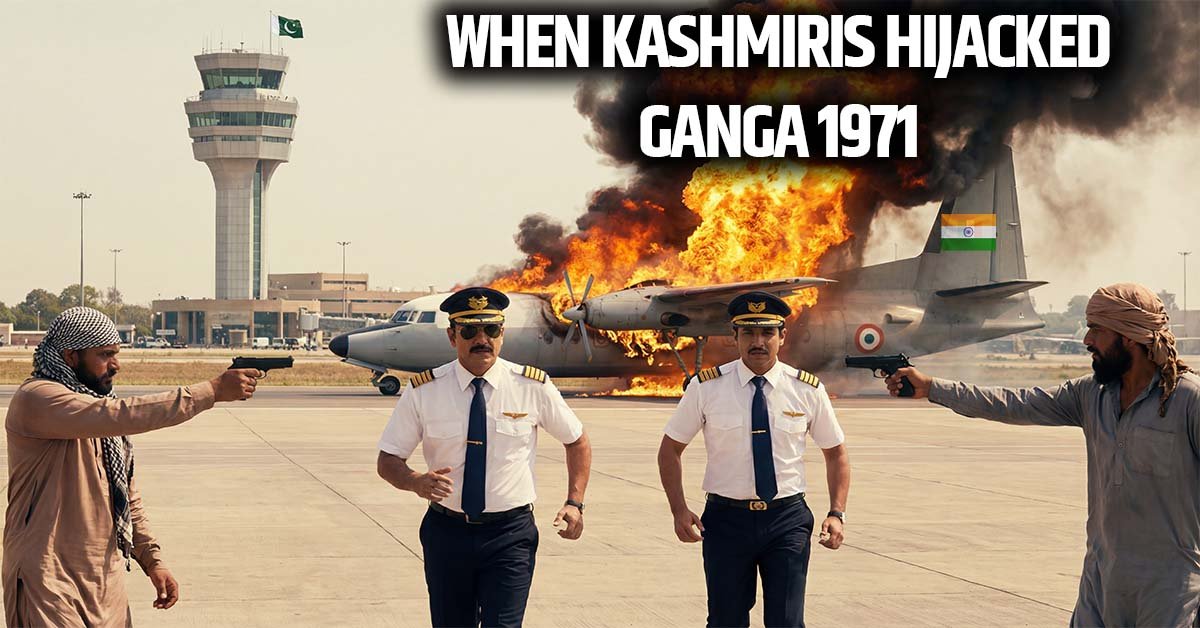
Ganga Plane Takeoff 1971
On 30 January 1971, at about 11:30 in the morning, when a Fokker aircraft named Ganga took off from Srinagar, Kashmir for Jammu, there were a total of 30 people on board, including the crew. However, some of them were actually agents of India’s intelligence agency, RAW, travelling in the guise of ordinary passengers. Among them were also two young Kashmiri hijackers, seated separately, who were about to seize control of the Ganga aircraft within moments.
Hijackers: Hashim & Ashraf Qureshi
These two hijackers were Hashim Qureshi, only seventeen years old, and his nineteen-year-old relative, Ashraf Qureshi. Both belonged to Indian-administered Kashmir.
Interestingly, this was the first time either of them had ever travelled by air, and they were doing so with the intention of hijacking the aircraft. As a result, both were initially confused and hesitant, unsure of how they would take the passengers and crew hostage and gain control of the plane. Their anxiety increased when the pilot announced that the aircraft would be landing at Jammu Airport in just a few minutes.
Hijacking the Aircraft
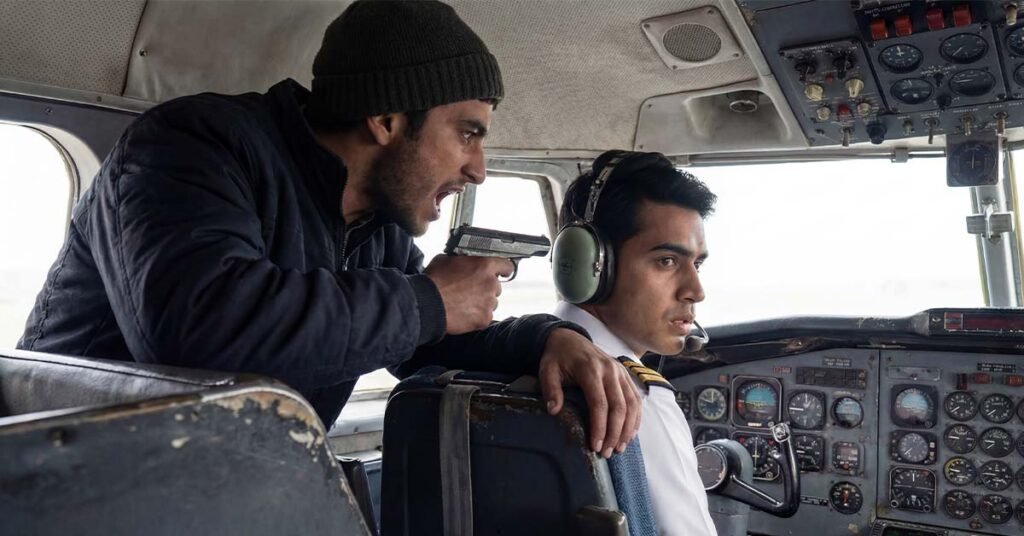
Time was running out for them to hijack the aircraft. At that moment, Ashraf Qureshi quickly opened his briefcase, pulled out a pistol, and handed it to Hashim Qureshi. Hashim took the pistol and immediately ran toward the cockpit. Entering the cockpit, he pressed the weapon against the pilot’s temple and said:
“Your aircraft has been hijacked. Fly it to Rawalpindi, Pakistan, immediately.”
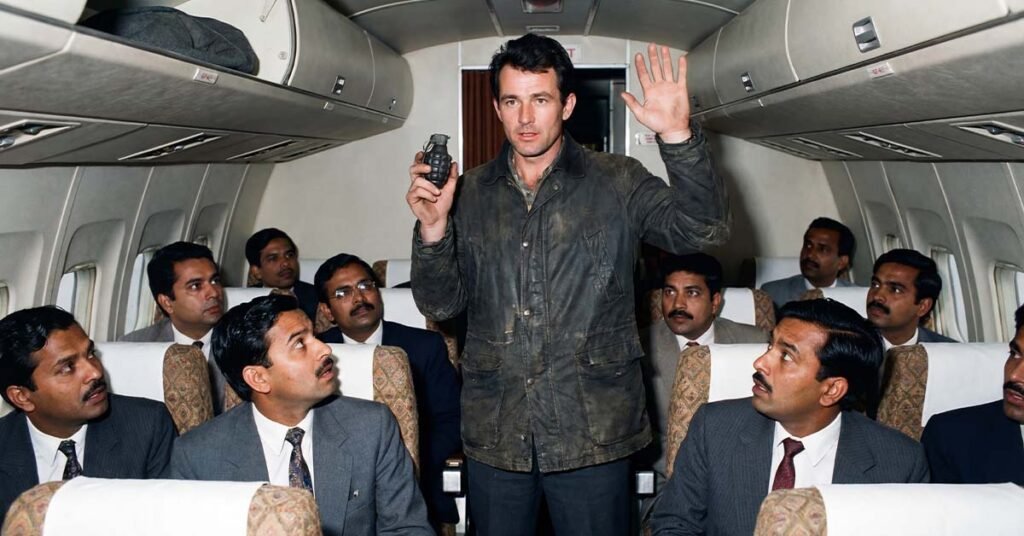
Meanwhile, after giving the pistol to Hashim, Ashraf took a grenade out of his briefcase. Stepping in front of the passengers, he raised the grenade in his hand and shouted:
“Everyone, raise your hands! Otherwise, I will detonate this bomb. All of you will die, and the aircraft will be destroyed.”
Hearing this, all the passengers on the Ganga were terrified. Among them were RAW agents disguised as civilians. One of these agents asked the hijacker:
“What kind of grenade is that?”
Ashraf Qureshi responded instantly:
“I can detonate it right now and show you. Then you’ll know exactly what kind of hand grenade it is.”
Hearing this, the RAW agent pretended to be frightened.
Inside the cockpit, the second hijacker, Hashim Qureshi, continued to hold his pistol to the back of pilot Oberoi’s head, repeatedly ordering him to fly the Ganga to Rawalpindi, Pakistan.
Pilot Diverts Flight to Lahore
Pilot Oberoi informed Hashim Qureshi that the aircraft did not have enough fuel to reach Rawalpindi. It would crash before arriving. However, Lahore was nearby, and with the remaining fuel they could safely land at Lahore Airport.
Hashim warned him that any attempt at deception would result in him being shot, and his partner would detonate the bomb, killing the passengers and destroying the aircraft.
After issuing this warning, Hashim granted permission for the plane to be diverted to Lahore Airport.
A short while later, pilot Oberoi contacted Air Traffic Control using the coded phrase, saying:
“Lahore, Lahore.”
But on the other end, a Sikh officer replied in a heavy voice:
“This is not Lahore, this is Amritsar.”
Hashim Qureshi immediately understood the pilot’s attempt at deception. In the next moment, he slapped Oberoi hard, seized control of the wireless himself, and ordered the pilot to connect him directly with the Lahore Airport control tower.
This time, the pilot established the connection with Lahore.
As soon as communication with Lahore Air Traffic Control began, Hashim Qureshi announced, “We are two Kashmiri mujahideen, and we have hijacked an Indian aircraft. There are passengers and crew on board. Grant us permission to land.”
However, the Lahore control tower did not allow them to land. Instead, they contacted higher authorities to report the situation.
Hashim Qureshi called again, and pilot Oberoi also informed the control tower that the aircraft had very little fuel and might crash if permission was not granted.
Even then, the control tower refused to authorize a landing. In fact, to prevent the aircraft from landing by force, airport security vehicles were positioned on the runway.
Lahore Landing & Negotiations
Despite this, due to critically low fuel, the hijackers and the pilot were compelled to land the plane at Lahore Airport, which they did safely at about 1:30 p.m.
Security forces immediately surrounded the aircraft and began negotiations with the hijackers. The hijackers demanded the release of their thirty-five associates imprisoned in Indian jails, warning that if their demand was not met, they would kill all the passengers.
Roots of the Conspiracy
The hijacking of the Ganga was not intended solely to highlight the Kashmir issue. Indian intelligence agencies themselves played a role in it. Their aim was to tarnish Pakistan’s reputation internationally, to push for sanctions against it, and to develop an air-war strategy for the upcoming conflict in East Pakistan.
The initial plan for the hijacking had been conceived in Rawalpindi by Kashmiri freedom activists, with Maqbool Bhat playing a prominent role. Their objective was to hijack an Indian plane to draw global attention to the struggle for Kashmir’s independence—similar to the tactics adopted by Palestinian militants at that time. For this purpose, 17-year-old Hashim Qureshi from Srinagar was selected, as he had come to Pakistan for some work.
After receiving basic training, Hashim was sent back to Kashmir to carry out the hijacking. However, while crossing the border, he was arrested by the Border Security Force (BSF). During Indian interrogation, he confessed to the plan and immediately agreed to cooperate, even accepting a proposal to assist the police.
When this matter came to the attention of India’s intelligence agency, RAW, they devised a broader strategy: to use Hashim Qureshi as a newly recruited agent to stage the hijacking of their own retired Ganga aircraft, damage it according to plan, and then place the blame on Pakistan. The objective was to justify closing Indian airspace to Pakistani flights—especially those traveling between West and East Pakistan—in order to restrict Pakistan’s ability to provide support during the upcoming conflict in East Pakistan.
This was the period when the Mukti Bahini was gaining strength in East Pakistan, and India was supplying them with weapons and training. Therefore, India needed an international justification to block its airspace to Pakistan, and the Ganga hijacking successfully provided that pretext. Interestingly, for this very purpose, India took its retired Ganga aircraft out of the scrapyard and assigned it to this operation.
To execute the hijacking plan, Hashim Qureshi enlisted the help of his relative, Ashraf Qureshi. To frighten the passengers and crew, both purchased a toy pistol that closely resembled a real firearm. They also crafted a wooden hand grenade and painted it in such a way that it looked entirely genuine.
When the two hijackers boarded the aircraft at Srinagar Airport, Indian intelligence agencies deliberately allowed them to proceed. Several Indian agents also boarded the flight to ensure that, according to the plan, the Ganga could later be destroyed, providing a justification for closing Indian airspace to Pakistan.
Public Welcome at Lahore Airport
When the Ganga landed in Lahore, Radio Pakistan announced that two young Kashmiri freedom fighters had hijacked an Indian aircraft and brought it to Lahore. Crowds in Lahore formed processions and gathered at the airport, chanting slogans in support of the Kashmiri freedom fighters, Hashim Qureshi and Ashraf Qureshi. People from various parts of the country, especially Azad Kashmir, also arrived at Lahore Airport to pay tribute to the Qureshi brothers.
Pakistani authorities and the Indian High Commission began negotiations with the hijackers. In February 1971, Pakistan was under the presidency of Yahya Khan. The country was already experiencing political tension following the recent general elections.
According to the election results, Sheikh Mujib had achieved a clean sweep in East Pakistan and had secured the highest number of seats in all of Pakistan, making him constitutionally entitled to form the government. In West Pakistan, Zulfikar Ali Bhutto’s party had won the most seats. Sheikh Mujib sought authority over both East and West Pakistan in line with the election results, while Bhutto, on the basis of his majority in West Pakistan, insisted that governance of West Pakistan should remain under his leadership. This disagreement had created a deadlock between the two leaders.
During the same period, the separatist movement for Bangladesh began gaining momentum in East Pakistan—an uprising in which India became fully involved.
Hijacker Hashim Qureshi went to the airport lounge and spoke on the phone with another Kashmiri separatist based in Pakistan, Dr. Farooq Haider. Following his advice, the hijackers first released the women and children.
A little later, Dr. Farooq Haider again instructed them by phone to release the remaining passengers as well, and to keep control only of the aircraft. Acting on this, the hijackers freed all the passengers and remained inside the empty Ganga aircraft.
During this period, people from various parts of the country continued to arrive at Lahore Airport in the form of rallies, expressing their support for Kashmir’s freedom. However, at no point did the Government of Pakistan attempt to arrest the hijackers.
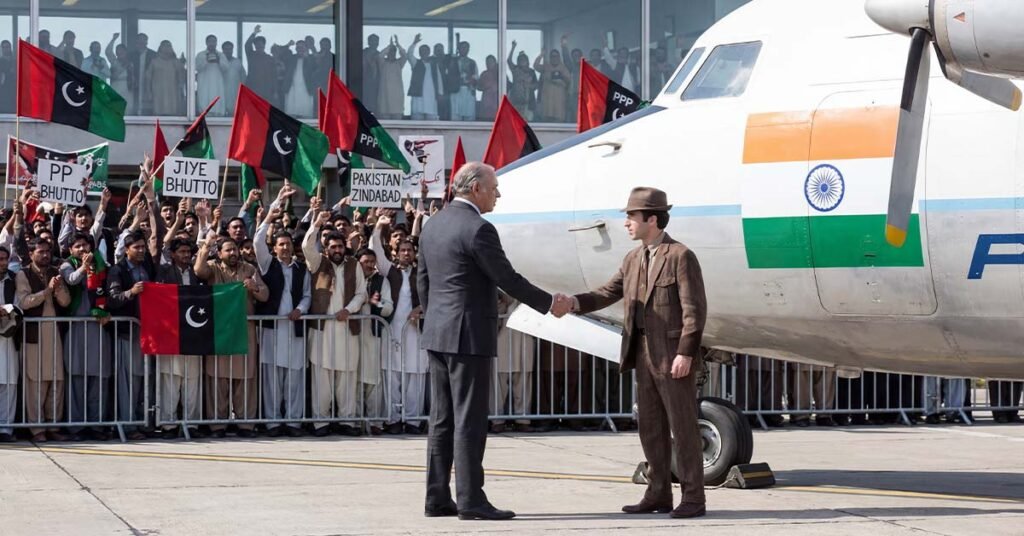
On 2 February 1971, Zulfikar Ali Bhutto and workers of his party arrived at Lahore Airport in a procession, chanting slogans in support of Kashmir’s independence. When Bhutto approached the Ganga aircraft, Hashim Qureshi stepped out and, with respect, bowed slightly as he greeted Bhutto—an image that was captured by photographers present at the scene.
Maqbool Bhat’s Orders & Plane Fire
Later, in an interview given to BBC, hijacker Hashim Qureshi claimed that on 2 February, Maqbool Bhat had instructed them to set the aircraft on fire and exit, explaining that the news would then spread worldwide and bring global attention to the Kashmir issue.
Following these instructions, Hashim Qureshi and Ashraf Qureshi first poured fuel inside the Ganga aircraft and then ignited it. As the flames rapidly engulfed the plane, both hijackers were caught in the fire and struggled to escape. During this chaos, both pilots were also injured by the flames and managed to exit the aircraft, after which they were admitted to Services Hospital in Lahore, where people came to visit and check on them.
After some time, Hashim and Ashraf were discharged from the hospital. Maqbool Bhat and other Kashmiri leaders came to pick them up, and they set off for Mirpur in Azad Kashmir. Along the way, they received a grand welcome in every city, and in some places, the celebrations caused traffic to remain blocked for hours.
Political Fallout & India’s Strategy
Meanwhile, India finalized its plan and on 4 February 1971 announced the closure of Indian airspace to Pakistani aircraft.
At that time, Pakistan was trying to rapidly transport military assistance from West to East Pakistan, relying on Indian airspace for the quickest route. India’s decision, however, created additional difficulties for an already troubled Pakistan. Pakistani aircraft now had to take a longer route: from Karachi over the Arabian Sea, then to Sri Lanka for refueling, before finally reaching Dhaka.
Meanwhile, Indira Gandhi pressured the weak Sri Lankan government, warning that if Sri Lanka allowed Pakistani planes to refuel, India would take strict measures against them.
Arrests & Pakistan’s Suspicion
On the other hand, following the airspace closure and intelligence reports, when Pakistan learned how India had orchestrated the hijacking of its own aircraft to create problems for Pakistan, the Yahya Khan government initially suspected the Kashmiri hijackers and Kashmiri separatists residing in Pakistan. Consequently, hundreds of Kashmiri freedom activists in the country, including the hijackers, were arrested. Those hijackers who had been accorded great respect just days earlier were now confined to interrogation rooms.
When this situation unfolded, Zulfikar Ali Bhutto also recounted that during his visit to East Pakistan, upon returning to Lahore, the crowd at the airport forcibly brought him to meet the hijackers.
The government formed a judicial commission to investigate the incident, which concluded that it had been a carefully planned Indian operation intended to blame Pakistan and justify the closure of its airspace.
Kashmiris Hijackers
Later, the court sentenced Hashim Qureshi to nine years in prison for being part of the Indian conspiracy, while Ashraf Qureshi and several other Kashmiri leaders received sentences until the dissolution of the court. Meanwhile, the restrictions on Pakistan’s access to Indian airspace remained in place until 1976.
After serving his nine-year sentence, Hashim Qureshi moved to the Netherlands. Upon his return to Kashmir in 2000, the Indian government filed a case against him for hijacking the aircraft, and he has been released on bail.
The other hijacker, Ashraf Qureshi, remained in Pakistan. He earned a BSc, Master’s, and PhD in Kashmir Studies from Punjab University, Lahore. Dr. Ashraf Qureshi later became the chairman of the Department of Kashmir Studies at Punjab University. However, in 2012, he passed away due to a heart attack and was buried in Mirpur, Azad Kashmir.
Military Coup: Nawaz Sharif vs. Pervez Musharraf’s Battle for Pakistan
General Zia’s Military Coup 1977: The Night Zia Overthrew Zulfikar Bhutto’s Government