
Better One Day as a Tiger than a Hundred as a Jackal
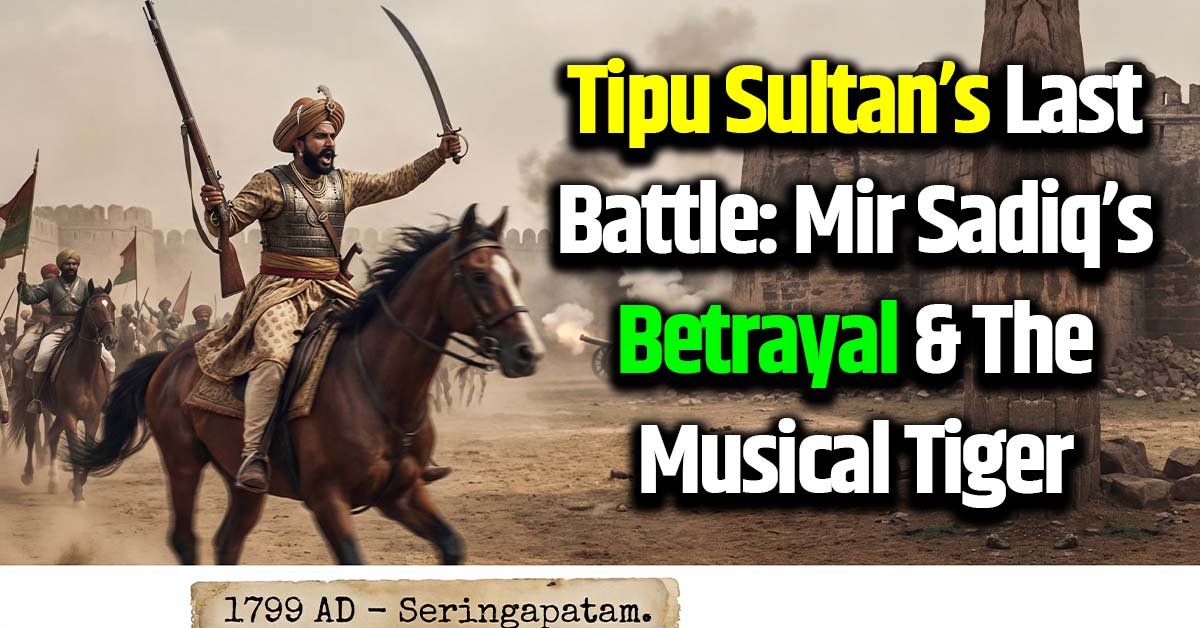
Raja Khan, overwhelmed with fear, pleaded with his wounded master, “Sultan, you are gravely injured. It is better to tell the British that you are Tipu Sultan, the fearless ruler whose last battle at Srirangapatnam has become legendary. They might spare your life.” Hearing this, Tipu instantly flared up in anger and rebuked his bodyguard, saying, “Have you gone mad? Stay silent!” He then repeated his famous words once again: “It is far better to live one day as a lion than a hundred years as a jackal.”
Meanwhile, two British soldiers approached the place where Tipu Sultan and his bodyguard Raja Khan lay severely wounded. One of the soldiers noticed Tipu’s magnificent sword, studded with diamonds and precious jewels, and attempted to snatch it from his hand. The soldier had no idea who the injured warrior truly was. At that moment, despite being drenched in blood and barely conscious, Tipu Sultan sprang up with lightning speed and beheaded the soldier with the very sword he was trying to steal.
In the chaos, another British soldier fired a shot from a short distance. The bullet struck Tipu Sultan directly in the forehead, and the Sultan collapsed.
The soldier who pulled the trigger had no idea that the man he had just killed was none other than Tipu Sultan himself—the very ruler the British army was desperately searching for inside the fort.
Tipu Sultan: A Lion Surrounded by Betrayal
At the beginning of 1799, the British East India Company, along with its allies—the Nizam of Hyderabad and the Marathas—launched their fourth and final war against the Kingdom of Mysore with nearly sixty thousand troops. In their quest to dominate India, Tipu Sultan was the single greatest obstacle in the path of the British. He possessed not only a modern and well-trained army, but also a strong and stable economy. To achieve their plans, the British began bribing and buying off Tipu’s ministers, advisers, and military commanders.
Among those who betrayed him was Mir Sadiq, one of Tipu Sultan’s most trusted ministers, who secretly entered into an agreement with the British. Mir Sadiq expanded his network of treachery within the royal court, recruiting several key generals and advisers. The major conspirators included Tipu’s finance minister Purnaiya, and two important military commanders—Syed Sahib and Qamaruddin. Even the commander of the fort where Tipu had positioned his strongest defenses, Mir Nadeem, had joined Mir Sadiq’s conspiracy. Sheikh Shahabuddin, an officer from the revenue department, was also in continuous contact with the British.
Tipu Sultan had an army of thirty thousand soldiers at his command, all equipped with superior weapons and fully capable of resisting the East India Company’s attack. The fort’s walls were armed with 287 cannons, whose devastating firepower forced the British forces to maintain their distance. Inside the fort, abundant supplies of grain and food had been stored. Tipu was fully prepared to endure a long siege and exhaust the enemy.
Mir Sadiq’s Treachery and the Fall of Srirangapatnam
But what proved most fatal for Tipu Sultan was not the strength of the British—it was the betrayal of his own men, whom he failed to recognize in time.
The Company’s forces began a relentless artillery bombardment on one section of the fort, aiming to blast open a large breach through which they could enter. Inside the fort, Mir Sadiq played a crucial role in guiding the British toward the exact location where the breach should be created. By the evening of May 3, 1799, the British and the Nizam’s armies had successfully broken through part of the fort’s wall.
Yet throughout this time, Tipu Sultan continued to receive reports assuring him that everything was under control. Instead of showing him the actual breach, the conspirators took him to another part of the fort and convinced him that there was no real threat.
Syed Ghaffar’s Brave Stand Against Conspirators
However, some of Tipu’s loyal commanders—such as Syed Ghaffar—were furious about the breach. Standing before his soldiers, Syed Ghaffar angrily declared:
“The Sultan is surrounded by flatterers—men who deceive him and do not even allow him to see the truth with his own eyes.”
On the morning of May 4, Tipu Sultan woke up, offered his prayers, and then consulted astrology to assess what the day held for him. The royal astrologers informed him that, according to the lunar calendar, May 4 was an unfortunate and dangerous day. To avert impending misfortune, they advised him to give charity. Tipu Sultan then distributed charity on a massive scale—donating elephants, buffaloes, oxen, goats, money, and oil.
Syed Ghaffar was now certain that the Company troops would soon storm the fort through the breach, and he immediately sent a detailed report to Tipu Sultan. However, the traitors intercepted the message and never allowed it to reach the Sultan.
Realizing the urgency, Syed Ghaffar ran toward the breach himself and began trying to block it. But the conspirators inside the fort secretly sent his exact location to the British artillery. Moments later, a cannonball landed near him, and Syed Ghaffar was martyred on the spot.
After the fall of a loyal commander like Syed Ghaffar, the traitors inside the fort, under the leadership of Mir Sadiq, raised a white flag from inside the walls—inviting the Company’s troops to enter the fort.
As the British soldiers marched toward the breach, Mir Sadiq executed a cunning and treacherous plan. He ordered the Mysorean troops stationed near the fort walls and the breach to move back, on the pretext of distributing their salaries. While these soldiers gathered behind to collect their pay, the fort commander, Mir Nadeem, also finalized his betrayal by stirring up another salary-related dispute among his men. As a result, the entire frontline defending the breach was left completely empty. The Company’s troops easily entered the fort without resistance. At this point, Mir Nadeem walked to the gates himself to welcome the British officers.
Tipu Sultan’s Last Charge: Courage Amidst Chaos
Meanwhile, Tipu Sultan had just finished giving charity and sat down to eat when he was informed of the death of his loyal companion, Syed Ghaffar. Tipu immediately stood up, leaving his meal untouched, shaken by the tragic news.
As he was still grieving the loss of his loyal commander, another devastating report reached him:
The enemy had breached the fort—and had already captured the opening.
Tipu was stunned. Only that very morning he had been shown another part of the wall, where no breach existed. And now he wondered: How had the British forces managed to enter the fort despite the fearsome barrage of Mysore’s cannons?
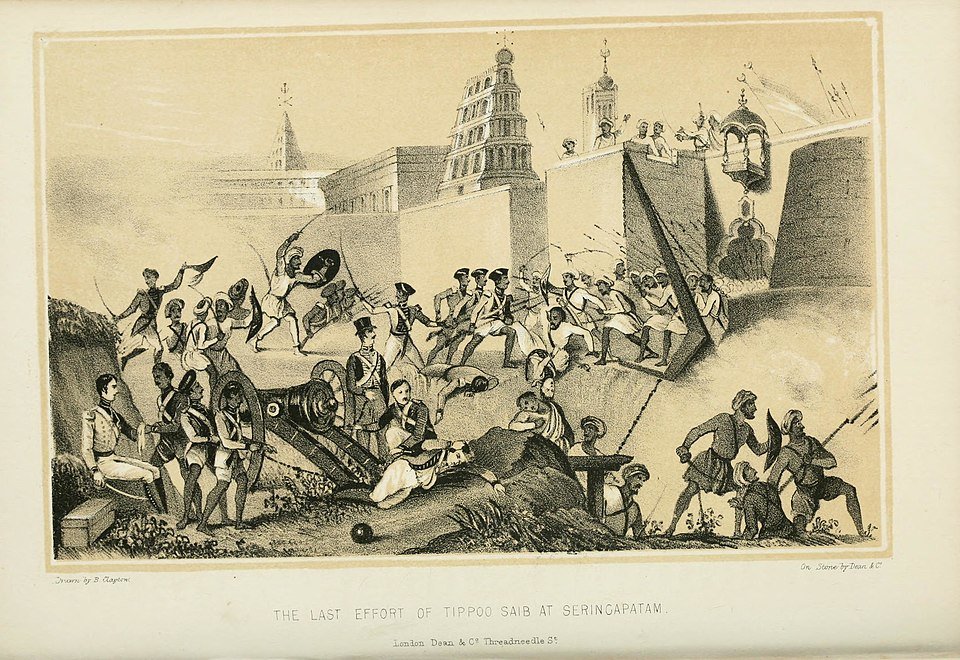
He then instructed the temple priests to continue their prayers, picked up his sword—secured in an ornate, jewel-encrusted belt—and slung it over his right shoulder. A small cartridge pouch hung from his left shoulder. Without wasting another moment, he mounted his horse and, shouting battle cries, charged toward the breached section of the fort. His loyal bodyguards and the royal physician, Raja Khan, rode alongside him.
But as he approached the area, still some distance from the breach, he saw the British Union Jack waving defiantly over the shattered wall. The Company’s troops were already pouring into the fort.
From nearly 200 yards away, Tipu Sultan raised his gun and fired seven or eight shots at the advancing soldiers. Raja Khan later stated that Tipu’s fire had killed three or four European soldiers.
Tipu then decided to halt the enemy’s advance with the help of the remaining Mysorean troops in the area. He began rallying his soldiers, raising their morale, and inspiring them to fight bravely. His men responded with fierce determination, and in the intense close combat that followed, several key British officers were killed by Tipu’s forces.
During this hand-to-hand fighting, Tipu’s horse was injured. He immediately called for his favorite horse and leapt into battle once again. Soon after, he received a deep wound in his chest. His companions urged him to retreat through the water gates of the fort, reorganize, and then launch a fresh counterattack.
Tipu agreed to the plan. But at that very moment, Mir Sadiq—who had arrived near Tipu—quietly ordered the water gate to be shut, ensuring that Tipu Sultan would have no escape route.
The Brutal End of Mir Sadiq: Justice for His Betrayal
Mir Sadiq then ran toward the second gate to have that one closed as well. But on the way, another loyal soldier of Tipu confronted him, blocking his path and drawing his sword. “Traitor!” he shouted. Mir Sadiq stopped abruptly and stared into his eyes. The soldier hurled vicious insults at him and said:
“You cursed man! You handed over a just ruler to his enemies, and now you try to escape? I will make you pay for your crime right here!”
In his book Tipu Sultan: The Saga of Mysore’s Interregnum, Vikram Sampath writes that after saying this, the soldier attacked the stunned Mir Sadiq and, with a swift strike of his sword, severed Mir Sadiq’s head from his body. “His impure body was dragged to a filthy spot and left there.” It is said that for a long time, people passing by the site of his killing would spit or throw shoes at the place, cursing him for betraying Tipu Sultan.
“Mysorean soldiers mutilated Mir Sadiq’s body in a brutal manner. Even after he was buried, his grave was dug up, and for two weeks men, women, and children gathered around and threw filth upon it. The British had to take severe measures to control the situation. Even today, those who respect Tipu throw stones toward the spot where Mir Sadiq was killed while passing by Srirangapatna.”
The Death of Tipu Sultan: Heroism and Betrayal
When the wounded Tipu Sultan found the water gates locked, he ordered them to be opened immediately. At that moment, the traitor Mir Nadeem—the fort commander—was standing on the roof above the water gate. Hearing the Sultan’s command, he deliberately turned his face away. Tipu now fully realized that a massive conspiracy had been orchestrated against him by his own traitors.
Tipu then moved toward the fort walls. His loyal bodyguard and physician, Raja Khan, was with him. When they reached the gates of the fort, they found the enemy already present in large numbers. Tipu drew his sword and charged at them fiercely. During the fighting, his favorite horse was killed, and Tipu himself suffered severe injuries.
Meanwhile, the treacherous commander Mir Nadeem led the British officers to the palace area where Tipu’s family—his wives and children—were residing. The British took Tipu’s sons into custody and interrogated them, asking where their father, Tipu Sultan, was. The princes replied that they did not know his whereabouts.
Raja Khan tried to remove Tipu from the saddle and place him inside a palanquin that was nearby. But in the process, both the Sultan and his physician fell onto a pile of dead bodies. Tipu’s turban also slipped to the ground. Nearly unconscious, Tipu’s lower body became entangled among the corpses.
Raja Khan, who was himself badly wounded, urged Tipu to reveal his identity to the enemy so that he could receive protection. But Tipu sternly rejected the suggestion and scolded him:
“Are you mad? Stay silent!”
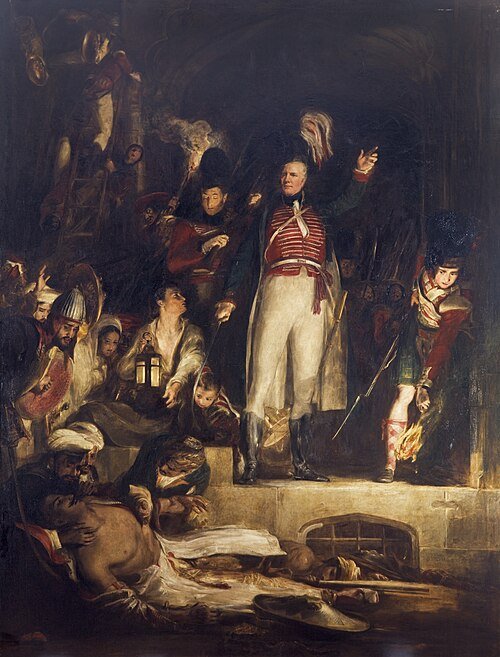
The British forces had gained full control of the fort, and dead bodies were scattered everywhere. Tipu Sultan and Raja Khan lay severely wounded beneath an archway inside the fort. At that moment, a group of British soldiers approached the area. They did not know that the wounded man before them was the Tiger of Mysore himself.
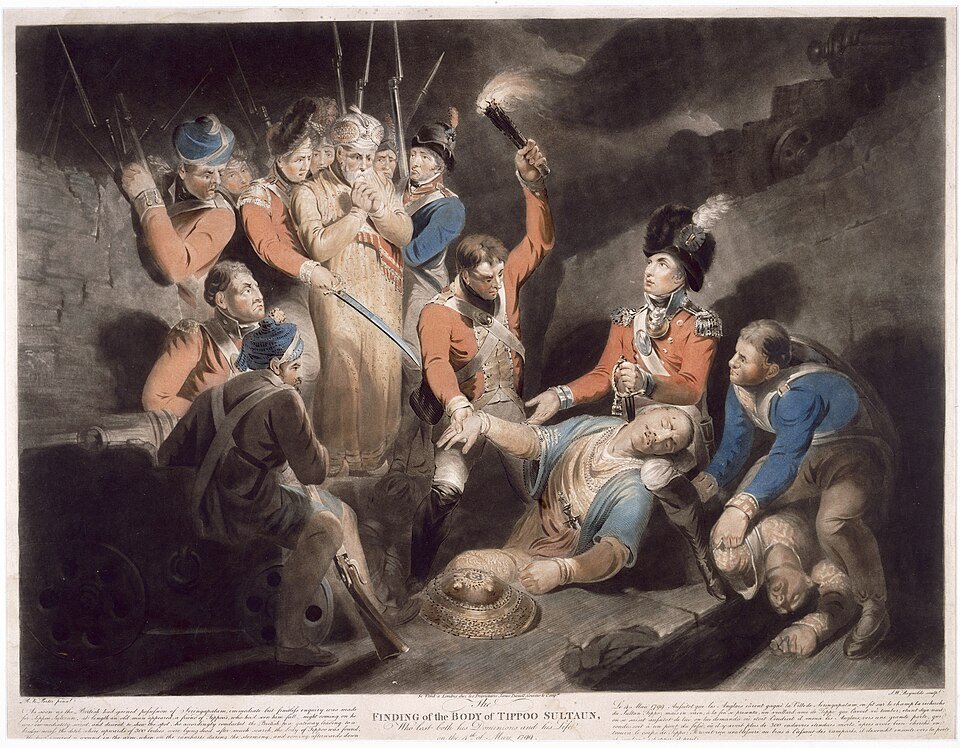
One British soldier’s eyes fell upon the Sultan’s jeweled sword-belt and the gold buckle attached to it. He stepped forward and tried to snatch the belt.
Enraged, Tipu Sultan lifted his sword and struck the British soldier with lightning speed. In response, one of the British soldiers fired his musket, and the bullet struck Tipu on the forehead. The Sultan fell where he lay.
Meanwhile, the treacherous fort commander, Mir Nadeem, was searching for Tipu Sultan with British officers. They found Raja Khan in a wounded state, and he pointed out the location of Tipu’s body. Mir Nadeem went close, inspected carefully, and confirmed that the fallen man was indeed Tipu Sultan.
The British soldiers were terrified; they hesitated to even touch the body, unsure whether he was truly dead. His body was still warm, his eyes remained open, and his hands were firmly clenched around the sword.
Historian Vikram Sampath notes that one of the major reasons for the fall of Srirangapatnam was undoubtedly the betrayal and negligence of Tipu Sultan’s senior officers, who had opened several pathways for the British. Many English historians have downplayed this aspect, as it tarnishes the narrative of their bravery and glory, revealing that the great fort was captured through cunning and treachery rather than sheer force alone.
The Musical Tiger: Tipu’s Unique Legacy
During the later search of the fort, British soldiers discovered a musical tiger toy inside. Carved and painted from wood to nearly life-size, it depicted a tiger attacking a soldier lying on the ground, dressed in a British uniform.
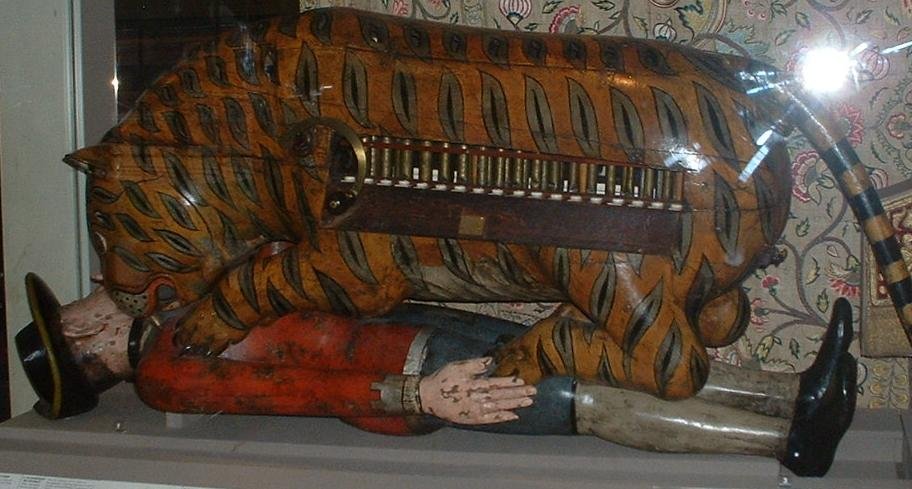
The toy was ingeniously designed so that turning a handle produced the simultaneous sound of the tiger’s roar and the victim’s screams. This was one of Tipu Sultan’s favorite toys, keeping him occupied during his waking hours and perhaps reflecting his intense and deep-seated hatred for the British. The toy was later sent to London, where it remains on display today at the Victoria and Albert Museum.
Sources
1. Vikram Sampath, Tipu Sultan: The Saga of Mysore’s Interregnum (1760–1799) (New Delhi: HarperCollins India, 2025),
2. Kate Brittlebank, Tiger: The Life of Tipu Sultan (New Delhi: Aleph Book Company, 2019),
The October 12, 1999 Military Coup: Nawaz Sharif vs. Pervez Musharraf’s Battle for Pakistan